
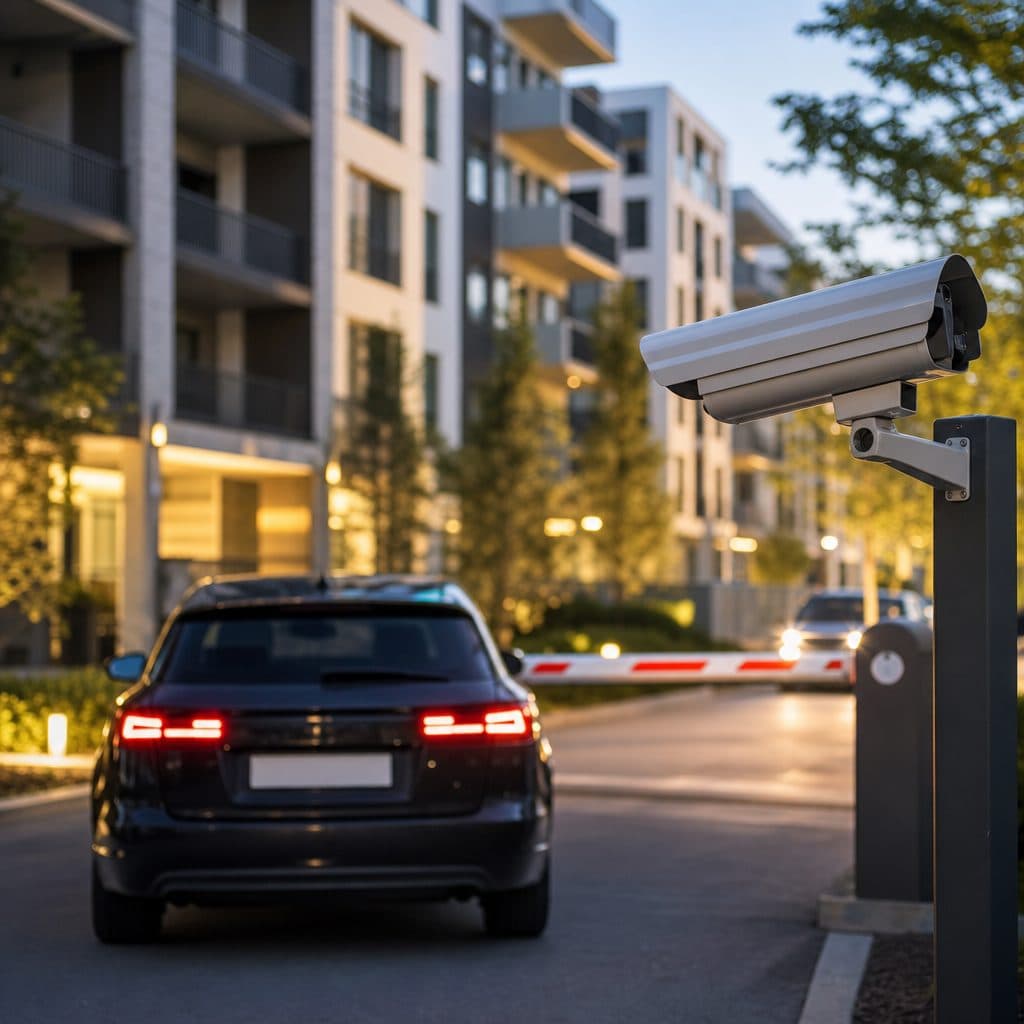
The Parking Problem License Plate Cameras Solve
Apartments, HOAs, and commercial parking lots all face the same practical problem: vehicles move faster than staff can document them. Unauthorized parking, tailgating, gate abuse, vandalism, dumped vehicles, resident disputes, and after-hours incidents often leave managers with partial stories and no reliable vehicle record.
License plate cameras help close that gap. They capture plate details at entrances, exits, drive lanes, and critical parking areas so a property team can verify when a vehicle arrived, where it traveled, and whether it belongs on site. The outcome is not just better video. It is faster investigations, stronger parking enforcement, clearer vendor oversight, and a more defensible way to manage access.
Why Standard Cameras Often Miss Plates
A conventional surveillance camera is designed to show context: people, vehicles, doors, landscaping, and overall activity. That wide view is useful, but it is not the same as plate capture. Plates are small, reflective, moving targets. At night, headlights can wash out the image. During the day, glare, angle, rain, dirt, or speed can make a plate unreadable. If the camera is mounted too high, too far away, or pointed across multiple lanes, the video may prove that a car was present without identifying it.
License plate cameras, often called LPR or ALPR cameras, are built for that specific task. The camera position, lens, shutter settings, illumination, and software are selected to record plates consistently in the expected vehicle path. For apartments, HOAs, and parking operators, that difference matters because the plate is often the key fact connecting a vehicle to a lease, permit, visitor pass, incident report, or tow decision.
 Proper camera placement turns vehicle movement into usable evidence.
Where License Plate Cameras Help Most
The best deployments focus on choke points, not every parking space. A choke point is a place where vehicles must slow, align, or stop. Capturing plates there creates a clean record while keeping the system practical to install, maintain, and review.
Resident and Tenant Parking
In multifamily properties, plate records help confirm whether a vehicle is assigned, permitted, expired, or unknown. Staff can resolve disputes with less guesswork and fewer repeated patrols.
HOA Gate and Amenity Access
Communities can compare plate events with gate logs, guest rules, vendor schedules, and clubhouse or pool activity. This helps boards separate normal activity from repeat rule violations.
Paid and Shared Parking Lots
Operators can document entry and exit patterns, identify repeat nonpayment, and support permit checks. The record is especially useful when attendants are not on site.
Security Investigations
When theft, damage, dumping, or harassment is reported, plate capture gives investigators a searchable vehicle clue. It helps narrow timelines before staff review broader video.
Key System Options to Compare
Not every property needs the same system. The right choice depends on lane layout, lighting, staffing, budget, retention needs, and how the records will be used. A small HOA entrance may require a different design than a mixed-use garage with multiple entry lanes and payment rules.
| Option | Best fit | Watch for |
|---|---|---|
| Fixed LPR cameras | Main entrances, exits, gate lanes, and garages | Must be aimed at a defined plate capture zone, not a broad overview |
| Overview camera plus LPR camera | High-activity areas where context and plate detail are both needed | Requires synchronization so staff can connect the plate read to the scene |
| Cloud-managed recording | Multi-site owners or teams that review events remotely | Confirm retention, user permissions, export process, and internet dependence |
| Local recording | Sites with limited bandwidth or strict on-site control preferences | Requires local storage planning, maintenance access, and backup procedures |
| Gate or access integration | Controlled communities, resident garages, and permit-based parking | Integration must be designed carefully so access decisions remain reliable |
For most properties, the recommended approach is a dedicated plate camera at each primary vehicle path, paired with an overview camera that shows the vehicle, driver-side activity, and surrounding context. The plate record identifies the vehicle; the overview camera explains what happened.
 Plate records are most useful when paired with clear site context.
Recommended Actions Before You Buy
Before selecting equipment, define the job. Many underperforming systems fail because the project started with a camera model instead of a traffic problem. Walk the property, identify vehicle paths, and document the decisions the system must support.
Step-by-Step Planning Checklist
- Start with use cases: enforcement, resident verification, incident review, visitor management, vendor tracking, or access control.
- Map all vehicle routes and mark where cars naturally slow, stop, or align.
- Choose capture points before choosing hardware; entrances and exits usually matter more than open aisles.
- Check lighting at night, at sunrise, and in rain if possible; glare problems change by time and season.
- Confirm lane width, vehicle speed, mounting height, cable path, network availability, and power.
- Decide who can search plate data, export clips, and approve enforcement actions.
- Set a retention policy that matches operational needs and any applicable legal or community requirements.
- Post clear parking and access rules so residents, guests, and vendors understand expectations.
- Train staff to search, verify, document, and escalate incidents consistently.
- Test the system with real vehicles before relying on it for enforcement.
A good test includes different plate types, vehicle heights, speeds, headlight conditions, and weather when available. If the property has delivery trucks, rideshare vehicles, motorcycles, or temporary tags, include them in testing. The goal is not perfection in every situation; it is predictable performance in the lanes that matter.
Risks and Mistakes to Avoid
License plate camera projects are straightforward when planned carefully, but small design errors can create unreliable results. The most common mistakes are avoidable, and recovery is usually possible if the team diagnoses the cause instead of blaming the technology.
Mistake 1: Using a General Camera as a Plate Camera
An overview camera may show the car, but it may not capture the plate reliably. Recovery: add a dedicated LPR camera at the correct angle, then keep the overview camera for context instead of replacing it.
Mistake 2: Mounting Too High or Too Far Away
A steep angle increases distortion and reduces readable detail. Recovery: move the camera closer to the capture zone, lower the mounting point when practical, or use a lens matched to the exact lane distance.
Mistake 3: Ignoring Privacy and Policy
Plate data should be treated as sensitive operational information. Property leaders should limit access, document why searches are performed, and avoid using the system for purposes outside posted rules or management policies. Assumption: local requirements may vary, so managers should ask qualified legal counsel about notice, retention, and enforcement language for their jurisdiction.
💡 Tip: If performance drops, review recent changes first: new lighting, lane striping, landscaping, signage, gate timing, or camera movement can affect plate capture.
How Apartments Can Use Plate Records
Apartment teams usually need a balance between resident convenience and enforceable rules. License plate cameras support that balance by giving staff a timeline for resident vehicles, guests, vendors, deliveries, and unknown cars. This can reduce argument-driven enforcement because staff can compare events against leases, permits, and visitor permissions.
- Verify whether a vehicle was on site during a reported incident.
- Identify repeat unauthorized vehicles before towing or issuing fines.
- Support move-in, move-out, and contractor scheduling by confirming arrivals.
- Help night staff or remote managers review events without walking every aisle.
For example, if a resident reports that an assigned space was occupied overnight, staff can search the plate camera for the suspected vehicle, confirm the entry time, and check whether it appeared on prior nights. That creates a clearer record before the team contacts the vehicle owner, updates permits, or starts a tow process.
How HOAs Benefit Without Overcomplicating Access
HOAs often manage community entrances, private roads, amenities, and guest rules with limited staff. A plate camera can give the board or management company a reliable vehicle log without requiring guards at every gate. The system is most useful when it supports existing policies rather than creating new rules no one can administer.
For controlled communities, plate records can help verify vendor hours, track repeat gate tailgating, and investigate damage to gates, mail areas, or common property. If an HOA uses decals, transponders, or keypads, plate cameras can serve as an audit layer, showing whether an access event matches the vehicle that actually entered.
Boards should be careful with communication. Tell residents what the cameras are for, who may review records, and how the information supports safety and rule enforcement. Plain explanations prevent unrealistic expectations and reduce concerns about arbitrary monitoring.
How Parking Lots and Garages Improve Operations
Public, employee, and shared parking facilities need more than incident video. They need a dependable record of vehicle activity that supports payment rules, permit checks, space turnover, and dispute resolution. License plate cameras can document when a vehicle entered, whether it remained past a permitted window, and whether the same plate appears repeatedly without authorization.
In a commercial lot, the system may help staff compare plate events with payment records or digital permits. In an employee garage, it can identify vehicles using reserved areas after hours. In a mixed-use property, it can help separate tenant, visitor, delivery, and retail activity when a complaint arises.
The important point is workflow. A camera alone does not enforce policy. Decide who reviews exceptions, how evidence is saved, when notices are sent, and when a tow vendor or security officer is contacted.
Implementation Checklist for a Reliable Deployment
Use this checklist as a practical starting point before installation day. It helps owners compare proposals and gives installers the details needed to design a system that works in the real lanes, not only on paper.
- Define each capture zone by lane, direction, and expected vehicle speed.
- Confirm camera height, angle, lens, lighting, power, network, and recording location.
- Pair LPR views with overview cameras where investigations require context.
- Create named user accounts instead of shared logins.
- Set retention, export, and audit procedures before enforcement begins.
- Test during day, night, wet pavement, and peak traffic.
- Document acceptable plate capture results and retest after any camera adjustment.
- Train managers, security staff, and parking vendors on the same process.
Ask vendors to explain the design in plain language. You should know what each camera is expected to capture, what it is not expected to capture, and how staff will retrieve records during a real incident.
A Short Decision Framework
Choose license plate cameras when vehicle identity is central to the problem. If your main concern is general awareness, a standard overview camera may be enough. If you need to connect a vehicle to a gate event, parking permit, resident complaint, payment record, or security incident, a dedicated plate capture design is usually the better tool.
The simplest decision is this: place LPR cameras where vehicles must pass, pair them with overview video, control who can use the data, and write the operating process before enforcement starts. That combination gives apartments, HOAs, and parking lots useful records without making the system harder than necessary.
Bring a simple map to that conversation: mark every entrance, exit, gate, visitor lane, reserved area, and recurring complaint location. Also note current cameras, lighting problems, internet access, and any parking software in use. Those details let an integrator separate must-have capture points from nice-to-have views and prepare a realistic scope. It also helps compare proposals on performance, not just camera count or price.
Ready to Review Your Parking Camera Plan?
Security and Life Integrations can help you evaluate entrances, exits, gates, garages, and parking rules, then recommend a practical camera layout that supports enforcement and investigations. Start with a site review and a clear list of the decisions your team needs the system to support.
Visit Security and Life Integrations